



Your brand sits neatly at the top of Google. Yet fewer and fewer visitors trickle in. Sound familiar?
Search is very much alive. The familiar search funnel has simply broken into pieces. Your customer starts with an AI assistant, then checks Google and watches a YouTube video. Next they dive into a Reddit thread, read a few reviews and only then land on your site.
So the gain lies in showing up everywhere. Become the answer AI recommends. In this article I walk you through the new search funnel, show how AI chooses brands and finish with a step-by-step plan. We start with what has shifted.
Search is alive, the old search funnel is gone
Search is dead, you hear everywhere. Yet your customer searches more often than ever. What did disappear is the search funnel as we knew it. Search traffic is moving, spreading across AI assistants, multiple search engines, communities and recommendation platforms.
First, look at what is really shifting. AI Overviews sit at the top of Google and ChatGPT is growing into a starting point. Assistants also help decide which shortlist your customer draws up. Answers that skip the click-through are the norm. Search has also become more conversational, with longer questions. Semrush even counted an AI Overview on almost a quarter of all searches last year.
Your rankings hold while your traffic drops. The cause is clear. The results page already answers the question itself. That is why 90% of the marketers surveyed point to AI Overviews and generative results as the cause of their traffic decline. People get their answer and stay put.
Meanwhile, discovery happens in places your dashboard misses. Google remains big. But Bing, ChatGPT, social channels and forums such as Reddit are rising fast as the first introduction to your brand.
The AI Monitor by Newcom shows that 7.2 million people in the Netherlands use AI in their daily lives, with ChatGPT in the lead. One thing stands out. AI hits your traffic harder than your revenue.
How your customer travels today
The old search funnel was straightforward. Someone had a need, searched Google, picked a site and bought. Pleasantly measurable. And easy to explain to your management team.
Today's search funnel starts the same way and then fans out widely. Say someone is researching a heat pump. They first open an AI assistant such as ChatGPT, Gemini or Siri. Then they look up the brands mentioned in Google, where a YouTube video appears that they watch for the details.
Then comes the biggest shift. They dive into Reddit to read what real people experience. The more content AI produces, the greater the need for a human perspective. Only after that come the reviews and finally your site.
In short, the journey has become longer and more winding. Your customer also jumps back and forth between those sources before choosing. The core point is clear. The answer is now shared across several platforms. Google remains dominant, yet for the first time in decades it is being challenged from several sides.
Researchers asked 220 marketers which AI platform will lead search in 2030. Google came out on top with 46%, well under half. For a brand that has been synonymous with search for twenty years, that figure speaks volumes.
The work of SEO has shifted in three ways
Discovery happens in more places than ever. So your brand belongs on review sites and in the sources of AI assistants. Add YouTube to that, now a search engine in its own right, plus LinkedIn and communities such as Reddit.
Now the good news. Many of those platforms still draw on your website, so strong classic SEO remains the foundation. What changes is how your content is picked up and shared. Text, images and video are all growing in importance.

From one position to presence everywhere
SEO used to be about the top spot on one results page. Today it is about presence on every surface where your customer asks their question. That journey is anything but straight.

From clicks to mentions before the click
The click still counts for plenty, even though it is shrinking. Ahrefs measured as many as 58% fewer click-throughs on position 1 in December 2025 whenever an AI Overview appears. On top of that now comes the mention that happens before the click. Think of brand mentions on external sites, on social media and within AI answers. That calls for an extra layer in your reporting.
From winning Google to being the answer everywhere
Winning Google remains important. The bigger goal is to be the answer wherever people ask the question. The shift underneath is huge. AI ranks answers instead of websites, assembled from several sources at once.
How AI puts its answer together
AI builds its answer in layers. It starts with training data, the foundation of billions of texts from which the model learns language patterns. That layer is largely fixed and has a cut-off date.
Live search indexes fill that gap. They process your question directly and match it with fresh texts, products or files. Next comes retrieval augmented generation, or RAG.
It works like this. The model first decides whether it needs fresh information, then consults a live index, re-ranks for relevance and reads the best passages. Finally, it forges an answer from those, with sources cited.
Three signals will sound familiar to anyone with an SEO background. Knowledge graphs record entities and their relationships, so the model verifies connections instead of guessing. That reduces hallucinations.
Structured data is the same schema markup we have been applying for years. Language models now use it to understand what your content actually is. Finally, trusted citations determine which sources the model quotes, usually with a link.
The lesson is simple. There are six inputs and you control five of them yourself, because the training data is fixed. That very loop determines whether your content gets picked up.
Ranking high and being cited are two different things
AI chooses its citations in its own way. As a result, ranking at the top rarely earns a citation anymore. In fact, the top spot often leads to being skipped. The link between ranking high and being cited has come loose.
Today only 38% of AI citations come from the top 10, compared with 76% in mid-2025. That is the finding of an analysis by Ahrefs of 863,000 keywords. A sharp decoupling in less than a year. What is more, three quarters of citations come from outside Google.
It goes further. In some datasets, most of the cited pages sit at position 21 or lower.
The conclusion for you as a business owner is clear. Build a separate layer of AI optimisation on top of your classic SEO, because from now on you need more than the old ranking reflex.
What makes AI recommend a brand
It takes more than a single factor. Brands that show up score on several points at once. Researchers asked marketers which factors AI weighs most heavily. This is how they ranked them.
- Brand mentions top the list with 4.8 out of 5. Every time your brand shows up somewhere, it counts.
- Brand authority follows closely with 4.7. This is the trust, credibility and expertise in your field.
- Content quality is right behind with 4.6. That makes sense, because the goal is always helpful and clear information.
- Structured data comes next at 3.8 and customer reviews at 3.6.
- Technical SEO scores 3.4, because bots still need to be able to crawl you. Backlinks close the list with 2.7, still valuable yet noticeably less dominant than before.
That spread is exactly the point. There are several levers at once.
Why brands get skipped
So why does AI skip a brand? Weak authority and thin content are the familiar causes. The most striking one is limited brand mentions.
Backlinks carry less weight than before, partly because unlinked brand mentions carry real weight. That fits the broad search funnel in this article. Language models look far beyond your site, so your brand should show up everywhere along the journey. Even where there is no link.
Weak entity signals come down to schema markup and how you write. Name brands, people, places and products clearly and consistently, every single time. And then the point we see missed most often, a lack of original insights.

Real-world example. Fewer visitors, more committed tenants
You can turn being skipped around. One example shows how. Take a property owner who lets commercial space. Her organic traffic fell by more than 30% when AI Overviews appeared.
In that market, visitor numbers say little. The tenants were on flexible open-ended contracts, so any month could be the last. She wanted tenants who would commit for at least a year. The real question became whether she is on the shortlist that AI draws up.
We then recorded each property as a data point of its own, with location, floor area, zoning and completion date. We also placed the figures on vacancy and lease terms in trade media and on regional business platforms. That is how we built brand mentions that AI reads as proof. Every mention makes the brand recognisable to the model.
The result is that the brand now shows up in four out of ten AI answers about commercial space in the region. Before, that was one in ten. The enquiries also come from decision-makers with clear requirements. Two of them signed straight away for at least a year instead of month to month. You find tenants like that through the shortlist, so it outweighs any visitor count.

The new SEO framework in six layers
Much of what always counted in SEO still counts. It is just half the story. Six layers together support the modern framework. You already know three of them: technical SEO, topical authority and content quality.
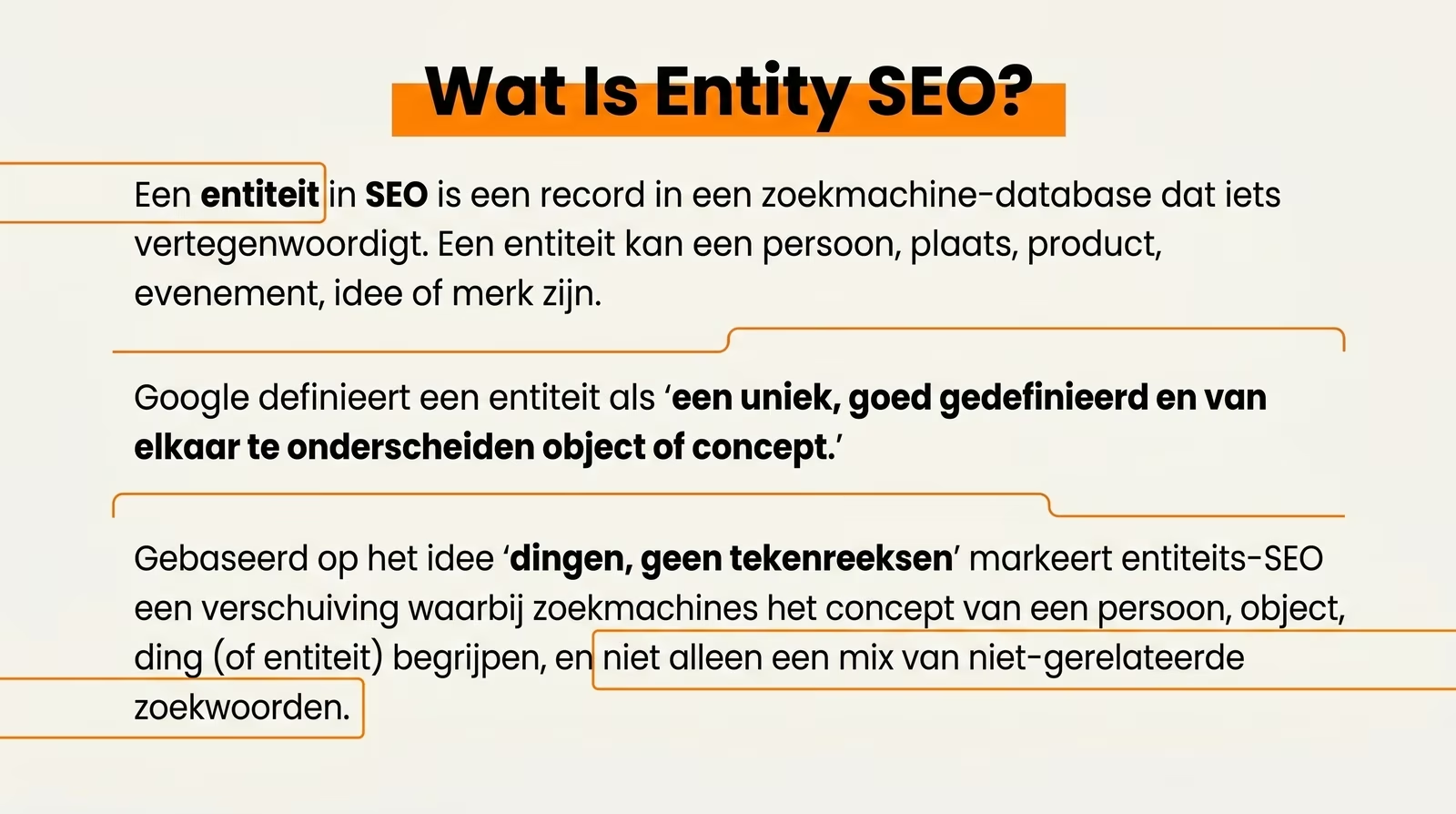
Entity SEO focuses on real things. People, places, brands, ideas and how they relate to each other, instead of individual keywords. This helps search engines and AI models place the meaning of your content and see where your brand fits in the knowledge network.
Digital PR earns editorial links and brand mentions with classic PR. You rarely pitch a sale. Instead, you supply the story, the original data or the insight a journalist genuinely wants to quote.
AI optimisation structures your content so AI finds it, understands it and adopts it. A simple example. Phrase a heading as a question and give the answer right below it. AI lifts that straight across as a citation.
Technical SEO versus entity SEO
Technical SEO asks whether AI can reach and read your site. Think clean crawlability, a logical structure and fast mobile pages. Fail here and you are sidelined before the match even starts.
Entity SEO asks a different question. Does AI know exactly who you are? This is about consistent brand, product and author signals that AI links to recognised entities. The price of failure is subtler. You remain a stranger. And AI rarely sticks its neck out for a stranger.
Start with authority
On the authority side, you start with topical authority. That means owning a whole topic instead of a handful of keywords. Add digital PR mentions beyond your own site. Together they keep search and AI engines mentioning you.
On the content side, quality means publishing what only you can write. AI optimisation then structures it so it can be cited. Together they make you worth citing.
This framework asks a lot at once, so where do you start? With authority. When researchers asked which SEO investment lasts longest, brand building came out on top. Digital PR followed close behind, with original research just below. Schema came last.
Authority is the most expensive and slowest work on that list. You show experience, expertise and credibility consistently, for years and across the whole web. In return, it lasts the longest. The rest fades faster.

Four reasons SEO strategies fall short
Before we push on, here are four pitfalls that trip up most strategies today.
Too focused on keywords. AI and classic search engines have long relied on more than individual keywords. So put keywords where they belong. Keep your content clear, in-depth and well structured for people and machines.

Building too little authority. Most brands drop out here because they are cautious with time and budget, while this is exactly what delivers the highest return. So put it at the core of your strategy.

Too little entity strategy. Consistent brand, product and author signals let AI recognise and cite you. Without them you remain a stranger. And AI rarely sticks its neck out for a stranger.
Limited visibility beyond your site. Now that search is fragmenting across platforms, your brand belongs in as many places as possible. From review sites to social media and shareable short video.

Content AI wants to cite
Once you know how AI chooses its sources, you focus on content AI wants to cite. Quality over quantity, every time. Better content earns more AI visibility than simply more content.
The formats that earn citations are the hardest to copy. So go for variety, such as lists, overviews, articles, product pages and how-to guides. That mix signals authority to AI.
Good content ages slowly. Depth outlasts freshness, so build something that stays worth citing. A fresh date on its own falls short. Cited content is 2.5 to 3.5 years old on average.
Structure your page so AI can cite it easily. Avoid long walls of text, unsupported claims and insights buried deep in a paragraph. Go for a direct answer, clear figures with a source and a scannable layout with subheadings.

The same applies at topic level. Add your own data or your customers' experiences, so your content becomes unique. Leave out generic AI filler and bring a real opinion. That is how you keep standing out.
Building authority beyond your site
The biggest opportunity lies beyond your site. Think of platforms that feed AI visibility, such as LinkedIn, YouTube and communities like Reddit. The wider your brand's presence there, the more authoritative AI considers you.
There is a threshold above which AI treats your brand as worth recommending. Visibility accelerates as more platforms mention you. So every mention counts.
AI then confirms that your brand is real, links you to your category and expands the knowledge graph. It reads mentions as trust, even where there is no link. Reviews carry a lot of weight here. So ask for them at the moment a customer is happy.
Back to the heat pump installer for a moment. Share customer stories on LinkedIn, for example. Post a YouTube explainer on choosing between air-to-water and hybrid. Answer questions in a relevant forum too. Every genuine mention increases the chance that AI recommends your business when someone asks for a reliable installer in the region.

Rethink how you measure success
In this landscape, your traffic drops while your revenue rises. So measuring success looks different. Starting early pays off, because many brands still leave AI out of their search strategy. That is exactly where your head start lies.
Rankings and traffic dominate what teams measure. Take a step to the side. Include AI citations, brand mentions and revenue too, so you see the whole story.
Also drop a few stubborn measurement mistakes. Let tiny fluctuations in individual keywords be. Always report traffic alongside a revenue or conversion figure. Keep an eye on your branded search demand as well.
The new scorecard includes your share of AI answers, branded search volume, qualified traffic, revenue from search, conversions and acquisition costs. For the management team it comes down to something simpler. What does search deliver in revenue, brand visibility and pipeline?

The action plan for the coming months
How do you turn this into a plan? We work in three phases, from foundation to revenue, exactly the rhythm of a free opportunity analysis.
Month 1 · Map your AI visibility
Start with an audit of your visibility, mentions and citations across the major language models. Then pick the low-hanging fruit. Sharpen your FAQs and structured data, because many models rely on them. Also refresh the pages that already carry authority every quarter.

Month 2 · Strengthen the foundation
First make sure the technology is solid. If bots struggle to find your content, language models will struggle just as much. Then build topic clusters around your core theme, set up author profiles and E-E-A-T signals and create strong commercial main pages.

Month 3 · Expand your authority
Finally, expand your authority. Weave original research through your social channels and use it in your outreach. Look for expert commentary opportunities and podcast slots. Publish case studies, because they show your expertise in places where AI is already looking.

What do you take back to your team? Search stayed, it spread out. So you need more than rankings alone, because it has long been about more than ten blue links. AI recommends brands it understands and trusts, so feed those signals. Front-runners are already moving towards broad visibility programmes. Your competitor will soon do the same.
Frequently asked questions about the new search funnel (FAQ)
Is SEO dead in the AI era?
Search is very much alive, only the old search funnel has gone. Traffic is being redistributed across AI assistants, search engines and communities. That is why strong SEO remains the foundation, complemented by AI optimisation and brand mentions.
Why is my traffic falling while my ranking stays the same?
The results page answers the question itself, so the same ranking delivers fewer clicks. Of the marketers surveyed, 90% name AI Overviews as the cause of their traffic decline. People get their answer and stay on the page.
How do I get into the answers of ChatGPT and Google AI?
First, build authority and brand mentions across multiple platforms. Next, structure content as a question with a direct answer below it. Then tighten up your schema and entity signals. That is how your brand gets cited.
Does ranking high in Google still count?
Yes, although it is now only half the story. Only 38% of AI citations come from the top 10, compared with 76% in mid-2025. So combine your ranking with broad visibility and authority.
What are brand mentions and why do they count?
A brand mention is every time your brand name appears in a trusted place, even without a link. They add up to a pattern that AI reads as proof that your brand is real and worth recommending.
How do I measure SEO success now?
From now on, look beyond rankings and traffic. Include AI citations, share of AI answers, branded search volume, revenue from search and conversions. That way you see the impact right down to the bottom line.