Published
 Updated
🕑 12 min
Take a look at the biggest shopping street in the Netherlands. It is no longer the Kalverstraat in Amsterdam, the Lijnbaan in Rotterdam or the Ginnekenstraat in Breda. It is the internet. Together, we spend tens of billions of euros online every year.
Think of it as the ultimate direct line to your customer. That smartphone in your hand? It has become the new front door of your business. These days, the money is shared out online. You really have no choice anymore: you join in or you get left behind.
Still, there have been shifts. It is no longer just about the traditional search engines of the past. We have landed in a new world and we need to adapt to it.
Take a look at the figures. Online sales are enormous. We are talking trillions of dollars. One of the most important ways people sell is through SEO and organic traffic. But the way you do SEO and generate traffic has changed.

You may hear it everywhere: "my impressions have dropped by 50%!" What does that mean? Well, a large share of those 'impressions' came from scrapers (such as the ChatGPT bots). Google has now made it 10x as expensive for those scrapers to collect data.
So your current impression numbers in Search Console are probably much more accurate than before.
The problem is that most SEO tools only show you part of the picture. They might say: "Hey, you can now track AI with us!" Then you pay thousands of euros extra for those features.
Look how quickly it happened:
If you look at the two competing realities, you see a clear difference:
If you are mentioned more often and more positively than your competitor, you win. Feeling and sentiment are crucial here. You need to be 'top of funnel', whichever solution your customer uses.

Search is still here, it has simply split up. You now have SEO (for Google), GEO (for AI engines) and even social media.
Did you know that around 6.5 billion searches a day happen on Instagram? Of course, people search for their friends, but they also search for content and products. Instagram is a gigantic discovery engine.
People use multiple search engines, just as they use multiple social networks. This is becoming the new norm.
The opportunities lie in all these searches. Almost two thirds of all buying journeys still start with a Google search. You cannot ignore that. AI Mode is also growing at lightning speed.
Whichever platform you look at, you want to be mentioned. The rules keep changing. The good news? You no longer have to wait years for results. We sometimes get our clients visible in AI Overviews within a few days of making changes.
Literally in days.

SEO is more complex than ever these days. AI is transforming how search engines process questions and how users find information about your brand.

It is no longer about 'keyword matching' (the process of linking the keywords used in online ads to the search terms people type into search engines such as Google). AI now understands questions the way a person does. And that means we need to adapt our optimisation strategies.
Those 'answer engines' are growing at lightning speed because users love them. They no longer have to wade through 10 blue links. For us as marketers, business owners and companies, this means we need a new playbook now that every AI engine 'reads' and cites content in its own slightly different way.
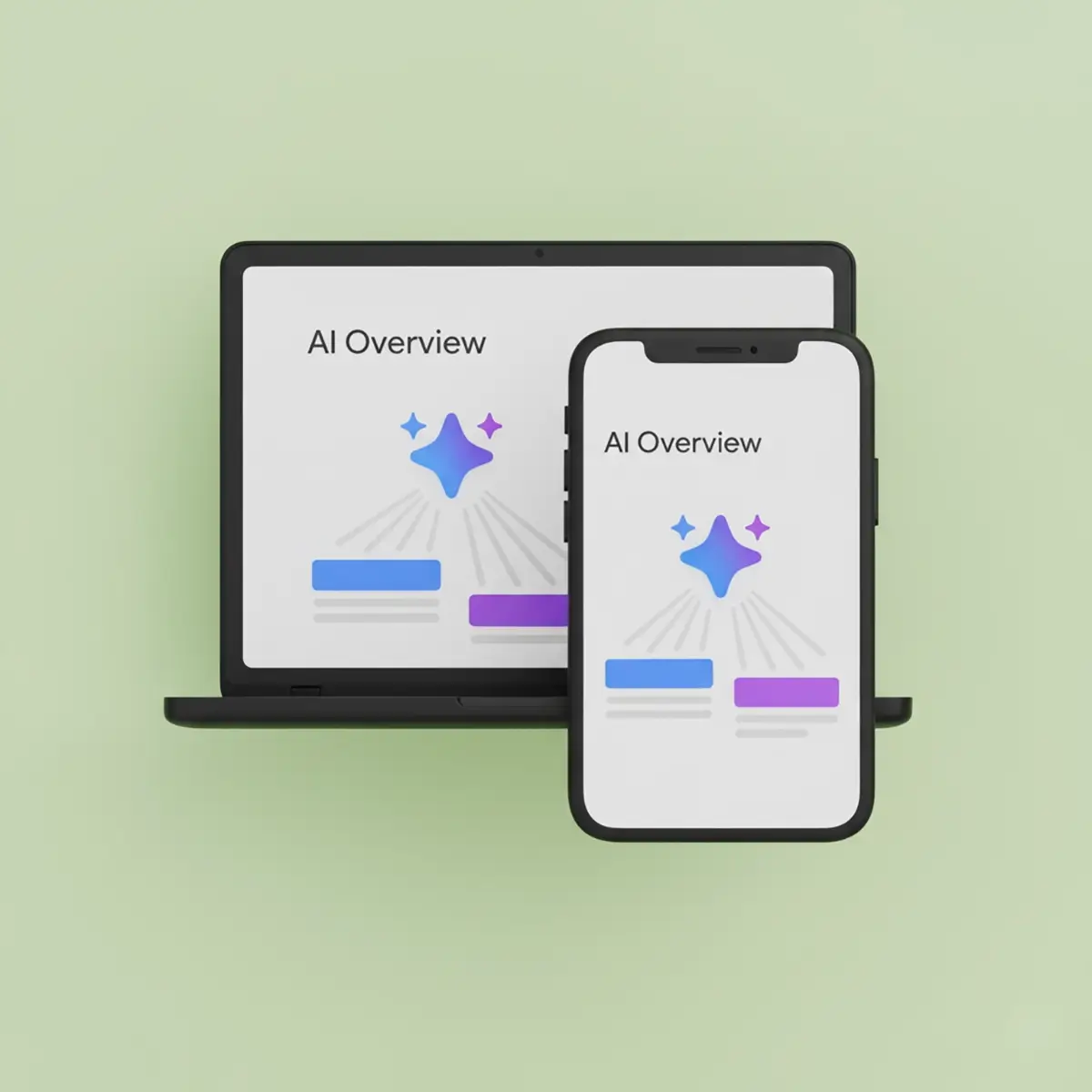
And remember Google's AI Overviews too. They take up a huge amount of space at the top of the page, especially for informational questions. If you search for "how do I get a pay rise?", you no longer even need to click a link.
Without the right tools, it is harder than ever to understand your visibility everywhere and to know where customers come across your brand.
Let's define it precisely.
Your 'AI Search Visibility' is simply your share of AI answers. It shows how often your brand is mentioned, cited (used as a source) or recommended for a specific topic, in your language and in your location.
To make it even clearer:
We have developed a watertight four-step process for this.
The scoring model itself is fairly easy to understand:

How do you dominate the new AI landscape? It comes down to three simple, powerful pillars: See, Predict and Win.
You need visibility before anything else.
Stay one step ahead of the changes.
Win the game by being the best answer. .
Okay, your new reality (hopefully you are starting to see it now) has to account for both traditional SEO and AI search. You really do not want to be one of the 73% of brands that struggle with how to measure and improve their presence in AI search.
So now we are going to take your new SEO playbook and walk you through it. It is a playbook built for the growing world of AI search we keep talking about.
And we want to tell you straight away: just like SEO, AI search is no 'set and forget' job. It is a constant feedback loop.
To be used as a source (cited) in AI answers, technical SEO is crucial.
Okay, I will be honest with you: there is a lot of debate in the SEO world about whether Schema markup is a direct ranking factor for AI, or just a correlation.
What I can tell you is this: we know AI learns from the web (that is what 'Retrieval-Augmented Generation', or RAG, means – it is basically just Googling).
Schema helps you a great deal to score better in the traditional Google results and it improves your click-through rate. If you are more visible in Google, you automatically become more visible in AI search too.
My advice: maximise your Schema markup. It does a lot for your brand authority.
And also consider something like an llms.txt file. This is new. Just as you have a robots.txt file to give Google instructions, an llms.txt gives explicit instructions to AI models.

As I said, AI learns from the web. That is why the content you publish is so important.
The more positive mentions you have on trusted platforms, the greater the chance the AI includes your brand in its answers.
It is no longer just about traffic. It is about having a voice and 'training' the AI models with your expertise.
Want to win on searches like "best running shoes this year"? Then I recommend two things:
Not visible for those comparisons or other long-tail keywords? Then make sure you fill those content gaps. An outdoor brand we helped did exactly this and doubled its conversions, while improving its traditional rankings at the same time.

For service businesses, local prompts are a goldmine. Think of questions like "best dentist near me" or "plumber in Rotterdam". These are increasingly answered directly by AI.
To win here, you need a locally optimised content strategy (just like with traditional SEO).
This kind of content is crucial to make sure your brand gets mentioned at those all-important, ready-to-buy moments.

Agencies can use AI visibility data to win new clients and upsell existing ones. And if you want to keep your clients, you has to show them this kind of data and insight.
Over the past year, I have spoken to more directors than ever who want to hear our view on AI. Everyone is talking about it. They look to their agencies to make sure they are keeping their eye on the ball and staying ahead. So for agencies, this matters more than ever.

You can now compete with the big players thanks to affordable AI visibility data. With some of our clients who struggled to keep up in traditional SEO, we see that the playing field in AI search is more level.
Why? You may well have a better reputation and more positive mentions on other sites (off-site). Traditional SEO was about what you said on your own site. AI search is about what others say about you. If your reputation is rock solid, you may well have a better chance in AI search.

It all starts with what we discuss here:
In case it was not clear yet, let me say it one more time: the risks of ignoring AI search are huge.
Remember one thing about those AI engines and LLMs: they have a memory.
They know what happened in the past and they remember your history. So keep working on fixing mistakes, earning those citations and improving your offer. That is the only way to keep growing and do better in the future.
And one thing I cannot stress enough: brand mentions. You has to focus more on digital PR. We do this non-stop for our clients at zoekmachinespecialist.com. Digital PR is a fantastic way to score better in those AI answers.

Okay, let's sum up. This is what you need to remember:
A: The yardstick has shifted fundamentally. In the traditional 10 blue links, a click was the KPI. In the new reality of AI answers, a mention is the KPI. You no longer measure only traffic, you measure 'mindshare'. The ROI lies in your brand being named consistently as the authority or the recommended solution. This influences the buying decision before a customer even visits your website. So you measure success by your 'AI Search Visibility' score: the percentage of AI answers you dominate compared with your competitors.
A: On the contrary, they are more important than ever, but their role has changed. Your reputation (through Digital PR, reviews and external mentions) is why an AI will trust you. Your technical SEO (such as Schema markup and an llms.txt file) is how you help the AI understand the facts on your own site correctly and quickly. Follow this rule of thumb: You write content for people, but you structure it for AI. Without that technical structure, the AI cannot 'read' and cite your expertise correctly, even if you have a good reputation.
A: The risk is huge, for two crucial reasons. First, search has split up. While you wait, your competitors are optimising for the fast-growing group of users who use AI as their primary search engine. Second, AI models have a memory. Every day you go unmentioned, the AI 'learns' that your competitors are the relevant experts. The gap you build up now becomes exponentially harder to close later. This is no passing trend. It is a new reality.
The next step
Discover your biggest growth opportunities with a free opportunity analysis (worth €416) — a tailor-made report, free of charge and with no obligation.

About the author
Dominic Pietersz
Your dedicated point of contact
Dominic helps SMEs grow through Google and other channels. With his international experience, he turns challenges into concrete growth.
Follow Dominic on LinkedInInspiration · Walking down a shopping street, I realised the internet is the new Kalverstraat. That is how this piece on brand mentions as your new SEO KPI came about.