



Imagine your best content gets 0 clicks and still brings in revenue.
Business owners often fixate on clicks. That is an outdated metric. In the end, it is all about revenue. Search has not disappeared, it has moved. Search engines and AI models now answer questions directly in the search results.
People simply no longer need to click through. As soon as an AI cites your brand, your conversion rate rises sharply, even as visitor numbers on your website fall.
This time I share how you rank with SEO, AI SEO, GEO and even AEO. Whatever you want to call it, it all comes down to visibility.
Want a practical example straight away? Or want to know which steps to take for your own website? Click heading 8 alongside, under Independer.
Where does your customer search?
Google is still the market leader, it has just lost its monopoly on answers. AI tools such as ChatGPT, Claude and Gemini (with no fewer than 750 million users) are exploding. Your visibility now revolves around the holy trinity: your website, search engines and these LLMs.
The gap between traffic and influence
Your content is being found, it just brings you less traffic.
Between Q1 2024 and the end of 2025, the index for organic website traffic fell from 100 to 67. At the same time, the index for AI mentions shot up from 15 to 88. The gap between raw website traffic and your actual 'influence' is bigger than ever.
The 3 big shifts
Every business owner needs to move with these three changes:
- From search engines to answer engines: systems give the answer directly in the engine.
- From searches to conversations: users hold dialogues with the AI instead of typing in loose terms.
- From rankings to citations: look beyond traditional positions and focus fully on brand mentions.
Invisible in the machine = invisible in the market
Missing from AI Overviews? Then you simply do not exist at the decisive moment of purchase. A shocking fact from Moz: 88% of the sources cited by AI sit outside the traditional organic top 10.
Over 60% of consumers trust generative AI for purchase decisions. It delivers higher conversions than any other traffic source in history.
Visibility on 2 fronts
AI demands a completely different approach.
The model simply selects the most relevant information. For years we focused on position one in Google. Today that top position guarantees nothing when it comes to an AI citation. You now compete successfully on two fronts: high Google rankings and AI citations.
Investing in organic visibility gives your AI citations a serious boost. These two channels reinforce each other.

Make it easy for the robot
The AI constantly scans for concise, accurate and crystal-clear answers. Focus on this structure:
- Use clear bullet lists.
- Put the conclusion right at the top.
- Divide the text into logical sections with clear headings. Web consensus also carries a lot of weight: do independent sources confirm your story?
Four pillars for success
Focus sharply on these signals:
- Authority: the market recognises your brand as the absolute leader.
- Clarity: you give a tight answer the AI understands straight away.
- Consensus: other independent sources confirm your data.
- Recency: you share the most recent facts (put the current year in your titles).

Opportunities in your sector
SaaS, B2B Tech and Finance score AI citations en masse thanks to large volumes of tight content. Healthcare and Legal trail behind because of strict regulation. AI Overviews rarely appear for local searches. For 'Home and Garden' or 'Health' they appear all the more often.
Map out your playing field and beat your competitors.
Sentiment is everything. Are you recommended or torn apart?
It has become perfectly clear.
It is no longer only about traffic and positions. You are hunting for citations. You want to be the recommended solution within the AI models. So let's look at the new content model that will shape your strategy for the rest of the year and beyond. Here is one more thing to add to earning these citations.
Sentiment decides everything.
AI models mention your brand name regularly. The way they mention you – positively or negatively – determines whether your audience actually takes action and buys from you. The ultimate goal? To be cited more often than your competitors, and in an extremely positive light. Only then does the potential customer think: "I'm choosing this product or this company right now".
Being visible is step one, being the undisputed recommendation is the finish line.

The data behind the AI citations
At zoekmachinespecialist.com we put it to the test.
We analysed 242 different prompts across the “big four” AI platforms to find out exactly which content gets cited. The results are as follows:
- Listicles: 40% of all citations.
- Step-by-step guides: 20%.
- Opinion: 2%. This is often a bitter pill for business owners and brands that have invested for years in '10X content' (enormously long, exhaustive articles). These long, editorial guides bring in only 2% of citations. SEO strategy has simply shifted.
In the past, the focus was on extensive, keyword-heavy copy. Today everything hinges on the structure of your content. Content that can be scanned and extracted in a flash wins the citations. During our analyses I notice time and again that businesses produce content that misses this completely.
That is a wasted investment.
The 3 elements for every landing page
You now know what the AI prefers. Time to look at the actual structure of your pages. Every page you want to see in AI contains these three fundamental elements:
1. The answer right at the top (don't bury the lede!)
Always put the main point up front.
Skip the endless introductions that leave the conclusion for the very bottom. Think of those online recipes. You scroll through pages of nonsense about the author's grandmother before you finally see the ingredients. Or your visitor has an acute leak, but first has to wade through three paragraphs about the founding of the family business in 1992 and their 'passion for pipework' before the emergency number finally appears.
That model is a thing of the past. Put a razor-sharp, clear answer right at the top of the page.

8
2. Content Chunking (bite-sized blocks)
This is a buzzword that many marketers completely misunderstand.
'Chunking' simply means that your page consists of self-contained sections or paragraphs. The AI reads one such 'block' and grasps the context straight away, without having to analyse the rest of the text. This lets the model pull specific passages from your text and use them in its answer.

3. Third-party confirmation (Multi-source Reinforcement)
Your own website speaks only glowingly about your own brand.
That makes sense, yet the AI sees right through it. The model always looks for external validation to base its answers on. You claim on your website that you deliver the best product. It is up to external sources to confirm that. Without that confirmation from independent parties, the AI cites you exactly zero times.
The filter for your content planning
Use these principles as a filter for all your future content. For every new article or page, ask yourself: does this contain at least one of the following elements? If it is missing, start again straight away.
- A tight, direct definition (placed right at the top).
- A step-by-step plan (such as a list or a how-to guide).
- A comparison (comparison content is extremely valuable, as people use AI to make complex comparisons manageable).
- Data-backed facts (use unique, internal data nobody else has, so you force the algorithm to cite you instead of the rest). Extensive, narrative-driven copy still has its place. Simply always work at least one of these four elements into your structure if you are after citations.
The best real-world example. Independer
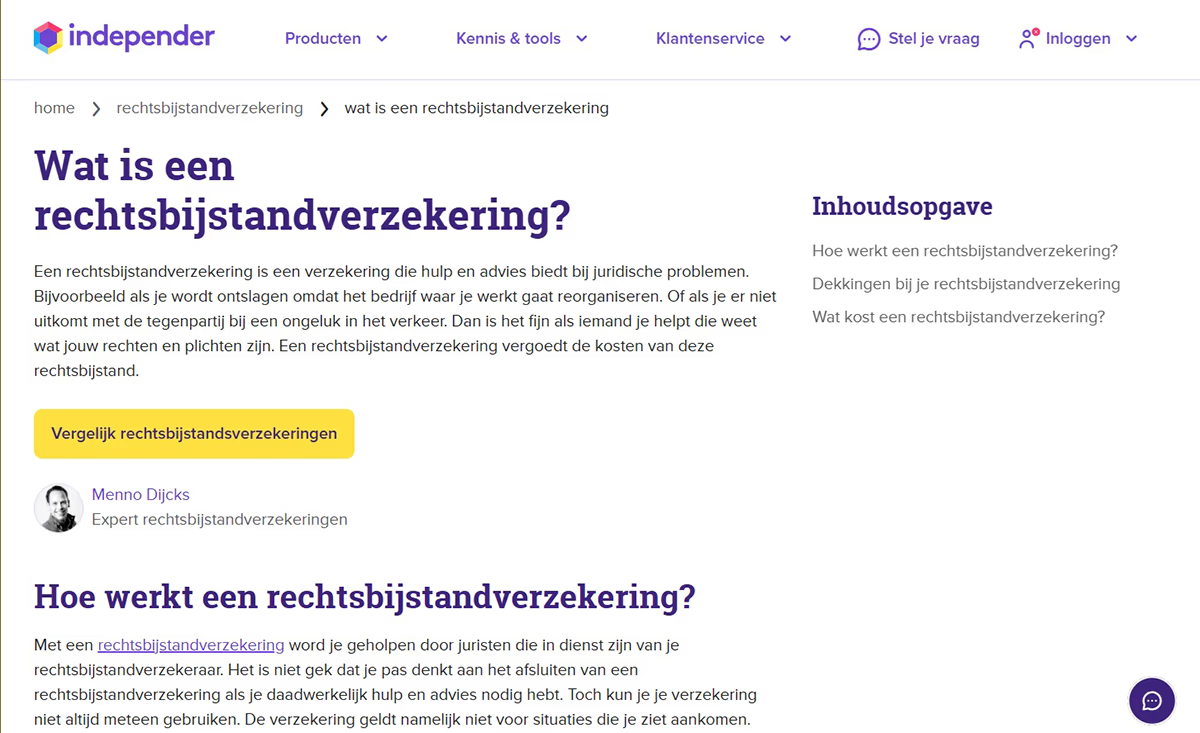
Business owners ask me remarkably often who really gets this right. Look at Independer, the Dutch comparison site. This is the gold standard. All their pages are set up entirely as 'the definitive answer'. Crystal-clear expert profiles (who wrote it, which specialist checked it?) show authority instantly, which sends huge trust signals. Combined with hundreds of thousands of registered customer reviews, this set-up proves their independence.
The result? For years they have dominated the complex and highly competitive Dutch market for insurance and financial products.
This structured approach pays off.
And now about your website
Let's name an uncomfortable reality.
You have no doubt invested heavily in your own website over the past few years. That was certainly not money down the drain. The rules have simply been rewritten. SEO used to be about the story you told about yourself on your own domain. Now the models demand that those claims are proven by external signals (off-site signals). When we look at the top sources AI pulls its data from, we see a crystal-clear pattern:
- User-generated content (Trustpilot, LinkedIn discussions) dominates the top.
- Blogs, news sites and external editorial content follow right behind.
- The official websites of brands dangle somewhere near the bottom. The AI simply places less value on your own promotional talk. The model is constantly looking for independent, external confirmation. No matter how good the content on your own website is, build up your external trust signals (off-site trust signals) as well as you can, or you will simply disappear from those AI answers.
You now write for at least 2 audiences (!)
Keep this firmly in mind while you make your planning. From now on you write for a dual audience. The classic SEO rules focus entirely on people. Delivering a great experience and quality copy. Now you write for the AI at the same time. Use the 'Independer’ structure we just went through.
This is the winning formula.
You serve the human reader perfectly, while the AI enjoys perfectly structured, crystal-clear answers that the system reads and extracts without a hitch.
And now, of course, you are thinking: how on earth do I become an Independer?
Don't panic. You do not need to invest millions in a giant platform with an army of programmers. It is about mindset and structure, not scale. You get there simply by becoming the most transparent, objective and clear source of information.
And that is more practical than you think:
1. Embrace the 'awkward' questions
What are your customers really searching for when they're at home on the sofa? They look for concrete prices, possible drawbacks, common problems and comparisons with your competitors. Tackle those topics head-on instead of avoiding them for fear of scaring customers off. Write an honest article about how the costs of your service are built up, or compare your product objectively with an alternative on the market.
The AI (and your customer!) laps up that radical transparency.

2. Make your data 'bite-sized' (structure is king)
Models scan for facts, not prose.
Use the toolbox of comparison sites: plenty of tables, tight bullet points and clear FAQ sections (Frequently Asked Questions). As I said earlier, put that razor-sharp answer right at the top and use the rest of the page for the in-depth substantiation.
Make it as easy as possible for the AI to soak up your facts.

3. Build an external review machine
You have to earn those crucial off-site signals.
Make gathering external proof part of your business process. Finished a successful project or delivered a great product? Instead of asking for a vague thank-you email for your own website, send a direct link to Trustpilot, Google Reviews or actively ask for a substantive contribution to a LinkedIn post. You do not need to dominate the internet with the biggest website. You simply need to be more honest, more structured and better backed by external sources than your direct competitor.
That is how you win with GEO.

The blind spot in Marketing
As a business owner, you steer on figures that tell only half the story.
Our research shows that almost every marketer monitors traffic. Yet only 6% analyse actual revenue and a meagre 2% look at ROI. Those last two figures are what truly reveal how effective your strategy is. AI disrupts this process further. It shapes buying intent and drives brand decisions well before a potential customer visits your website. Do you use only Google Analytics for reporting on traffic and positions?
Then you are ignoring the real influence of AI on your results. SEMRUSH has now built this in.
The secret of the big players: LTV
Large corporations set themselves apart by steering on a customer's lifetime value (LTV).
I see SMEs rarely use this strategy, while big players often accept a loss in the first year. They understand that over a five-year period a customer brings in a multiple of the acquisition costs.
That is how they maximise total profitability and market share.

4 key AI Statistics
Want to get a grip on your success in an AI-driven world? Focus on these four indicators:
- AI citation frequency: how often does your brand appear in answers to questions from your audience?
- Share of AI answers: how does your visibility compare with that of your competitors?
- Brand mentions and sentiment: presence in conversations is crucial, provided the tone stays positive and favourable.
- Assisted conversions via AI: use GA4 to analyse what share tools such as ChatGPT have in your funnel.

Start today. Perfect tomorrow.
Putting off your start until a perfect measurement method exists widens the gap with your competitors. Open ChatGPT or Perplexity today and enter the questions your audience asks. Does your brand appear in the answer? Is the mention positive? Record these findings systematically. That way you discover patterns and adjust where results lag behind.
AI visibility is more than a number
Treat your visibility as a serious, valuable metric.
It is anything but an empty statistic. Compare it with a new advertisement, which sometimes reaches people without any interest. A citation, on the other hand, responds directly to an active search query. This happens at the crucial moment just before a purchase.
The power of intent and conversion
ChatGPT acts as a personal shopping assistant for things like pillows or prams.
The buying intent here is crystal clear.
That is many times what other channels usually deliver.
Fast results with smart optimisation
Your AI citation score can rise at lightning speed.
Optimisations such as FAQs, sharp headings and step-by-step plans sometimes deliver results within 24 to 48 hours. Both SEO and GEO are vital today.
GEO often shows results faster than traditional search engine optimisation.
Convince the board with new Data
Use this data to convince your clients or management of the value of AI searches.
The old statistics tell only part of the story. These new figures give the full picture. Your brand's influence now takes effect before anyone visits your website. Start measuring this new data today to understand your full brand impact.
The dangers of waiting.
Here is an analysis of what happens once you ignore this development and decide to wait. Business owners who dismiss AI as a passing hype are missing the mark by a mile. Think back to the early years of traditional SEO.
The brands that started straight away back then built domain authority that cannot be copied. Now you look at those established names and think: "there's no competing with them any more, they've been at it for years." Exactly the same scenario is unfolding right now in the world of these new AI searches. This is the timeline if you stand still:
- 0 to 3 months. While you wait, your competitors claim the first AI recommendations.
- 3 to 9 months. The AI models anchor the hierarchy. The balance of power and the frontrunners in your industry are as good as fixed in the data.
- 9 months to 2 years. Your business has simply been wiped from the buying process. You no longer take part in your future customer's research phase. Just as with traditional SEO: the longer you put off your advance, the wider the gap with your competitors becomes.
The 3 action points for today
Take the following lessons to heart and put them into practice:
- Overhaul your old reports.
Adjust your current measuring tools straight away. Treat AI optimisation as a core part of your work, not an optional extra or a fun project for next year. Anchor this pillar at the heart of your marketing strategy today, or you will forever be playing catch-up. - Start immediately, forget perfection.
The brands conquering the market today do not wait for the perfect tool or a flawless dashboard. They dive straight in. Waiting for the ideal moment only leads to standstill. - Measure, adjust and scale up.
Start with the data you have available today. Carry out the first optimisations and then let the results determine your next steps.
In the marketing world we stick to one rock-solid rule: progress beats perfection.
Skip the wait for a flawless plan. Take the first step today and build your lead from there.

The big shift and the HUGE opportunity
This is where the real shift lies, and at the same time your biggest opportunity. Businesses that adapt their strategy today are shaping the future of online search. We just discussed the Independer example.
They are successful because they entered the market early.
If you want to copy Independer today, you face a gruelling task. It is unrealistic, whatever your budget. You would have to turn back time. And if you could turn back time, you would get a better return elsewhere, on the stock market for example. Right now you have a unique opportunity with AI searches. Seize it immediately and act now. Competition is getting tougher fast. Business owners who take the first step now see solid growth straight away and achieve a much higher return (ROI).
You now achieve results with far less effort than if you started a year or two from now. By then, holding on to your position will also take much more energy.

2
AI is the new front door. Why conversion beats everything.
AI acts as the new front door of your brand. You know this by now, yet we want to highlight one specific statistic. It is about more than the billions of euros spent online.
There is a far more important yardstick. According to SEMRUSH data, AI traffic converts about 4.4 times better than visitors from traditional organic searches. We put all marketing channels side by side based on conversion rate:
- AI traffic
- SMS marketing
- Email marketing
- Paid search

Traditional SEO and other channels follow much further behind. What stands out: AI traffic truly beats every other channel. Conversion via AI is about 2.5 times higher than with SMS marketing. It outperforms traditional search, paid ads, social media, email and SMS.
The intent is clear. You have every reason to embrace this channel. Seize that opportunity.
Frequently asked questions about scoring with AI SEO and GEO (FAQ)
Q: Why am I losing organic traffic?
A: Your target audience now does its research directly in AI tools and no longer clicks through for basic information. So all you lose is the 'noise'. The visitor who still clicks through from an AI citation has enormous buying intent. Data shows this AI traffic converts up to 4.4 times better than traditional search traffic. You make more revenue with fewer visitors.
Q: How do I get ChatGPT and Gemini to cite my website?
A: Ditch the long-winded introductions and put your key conclusion right at the top of the page. Structure your content in bite-sized blocks ('chunking') with clear lists and step-by-step plans, so the AI can scan the facts in a flash. Also make sure you have external confirmation through reviews or trusted platforms, because the robot places little value on your own promotional talk.
Q: Can I wait a little longer or should I start with this AI strategy right away?
A: If you wait, within 9 to 24 months you will simply be wiped from your potential customer's research phase. AI models are anchoring the new frontrunners in your industry right now. Anyone who hesitates now will soon face a gap that cannot be closed—much like the businesses that once missed the early years of SEO. Start right away, because progress beats perfection.