


Your visitors are dropping and you wonder whether Google is penalising you. Here you can read how to recognise a Google penalty, how a manual action differs from an algorithmic drop and what to do next.
What a Google penalty actually is
Did you see your visitors drop from one week to the next?
As a business owner, you are right to be alarmed. A website that has disappeared from Google costs enquiries, orders and revenue. The first thought is often that Google has punished you.

Such a Google penalty, or penalty on google as some people type it, comes in two forms. Google itself speaks of a manual or an algorithmic action. With the first, a person has reviewed your site. With the second, the automatic systems step in.
On top of that, a drop caused by a core update (a major change to how Google ranks pages) often feels like a punishment, while it is something quite different. That difference determines your whole approach, because every cause calls for its own recovery.
A Google penalty in 2026, with AI in the mix
In 2026, AI plays a part on two sides. Google tracks down spam with its own AI system. In 2026 Google has already rolled out four spam updates, in March, June, August and September, according to Google's status dashboard.
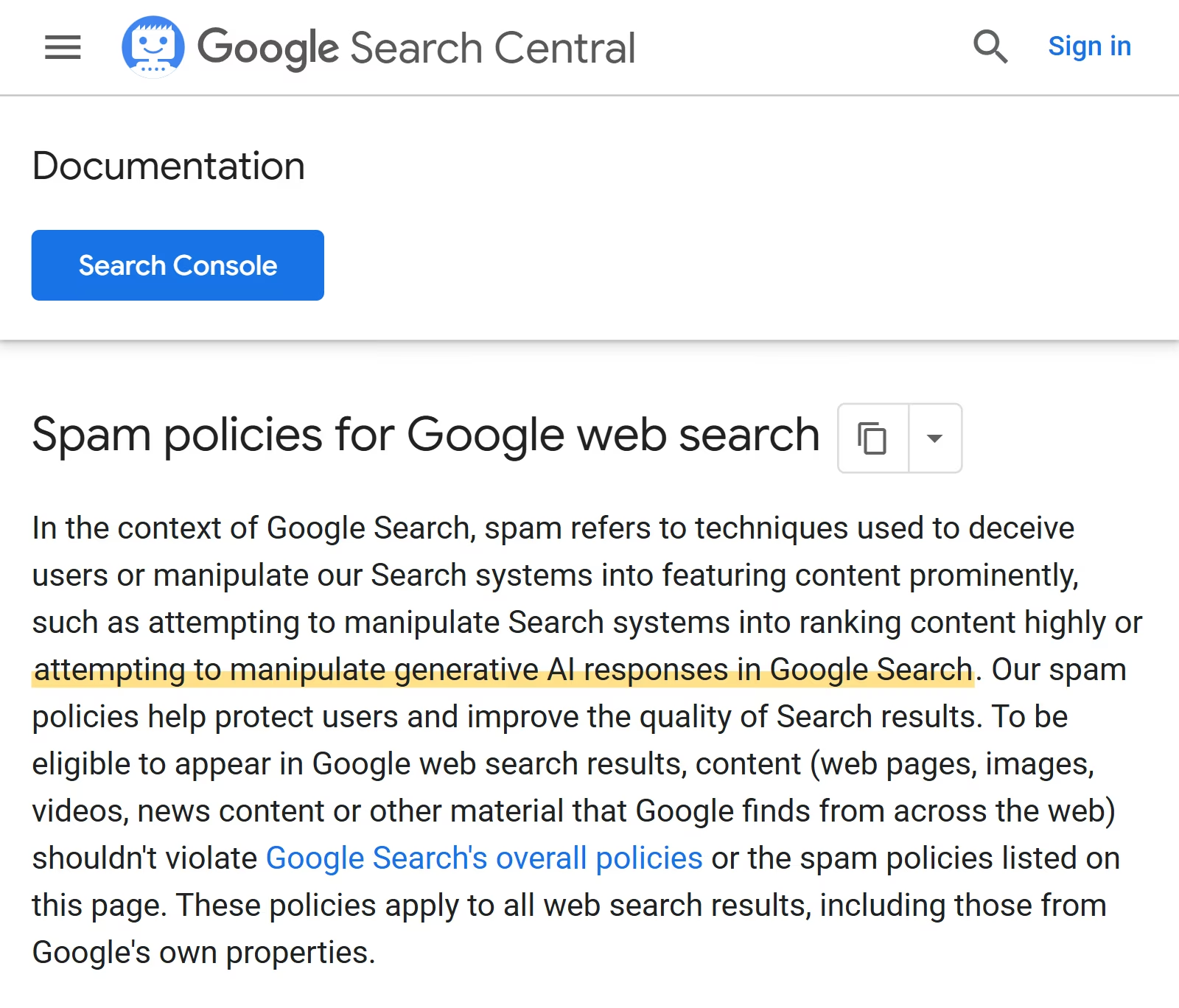
Since May 2026, the spam policies also apply to the answers AI gives in Google Search. If you try to steer those AI answers with tricks, that counts as spam.
Do you use AI for your texts? Since October 2026, Google asks you to fact-check all AI content yourself before publication. Creating many pages with AI that offer the reader little can fall under the scaled content rule.
I hear the word penalty in almost every first conversation about a falling graph. Often the cause turns out to be closer to home, such as a technical error or an outdated page.
Diagnosis first, treatment second.
Manual action, a person has reviewed your site
You get a manual action when a Google employee has determined that pages on your site violate the spam policies, Google explains in the Search Console Help. So there is a human judgement behind it.

Anyone searching for manual action google mostly finds scary stories. Yet this form has a big advantage. Google lets you know in the Manual actions report and in the Search Console message centre, according to the same help page. So you never have to guess.
How often does this happen? In 2020, Google sent more than 140 million messages via Search Console, of which 2.9 million were about manual actions against webspam, according to Google's annual overview.
These figures are somewhat older. The number of notifications about manual actions has fallen, because the algorithms catch more and more spam themselves, Google writes in that same overview. So when you see a drop, look beyond this one report too.
With a manual action, at least you know exactly where you stand.
Algorithmic action, the systems step in themselves
Do you see a drop while the Manual actions report stays empty?
Then you may be dealing with Google's automatic systems. SpamBrain, Google's AI system against spam, found almost six times as many spam sites in 2021 as in 2020, reports the webspam report for 2021.

As a result, hacked spam fell by 70% and gibberish spam on hosting platforms by 75%, according to that same report. Google states in the same piece that more than 99% of searches stayed free of spam.
If a spam update hits your site, recovery works differently from a manual action. According to Google, a site can improve when the automatic systems learn over the course of months that the site complies with the spam policies. So here you recover through your site itself.
Google is strict about link spam updates. The ranking benefit of those spam links is lost for good, Google writes. So build links that you earn. How that works, you can read in the article on getting backlinks.
In my experience, this waiting is the hardest part. Every week feels like a loss, while calm and thorough work deliver the most here.
A drop caused by a core update is something else
Suppose you drop just after a big Google update. Did you do something wrong?
Google is clear about this. Pages that perform less well after a core update comply with the guidelines and fall outside any manual or algorithmic action, Google wrote at the 2019 core update.
Your pages are fine in that case. In Google's eyes, other pages give a better answer to the searcher's question at that moment.

So a reconsideration request makes little sense here. You win back ground by making your content stronger for the reader. Think of up-to-date information, your own experience and a clear answer at the top. You can read more about this in the article on the helpful update.
A lower position says little about a violation.
How to do a Google penalty check
Do you want to know for sure where you stand? You go through a Google penalty check in a fixed order.
- Open the Manual actions report in Search Console. If there is a notification there, you have a manual action.
- Look at the Search Console message centre. A message about a manual action also appears there.
- Compare the date of your drop with Google's announced updates. If it coincides with a spam update or a core update, you know where to look.
- Look at which pages of your site Google shows. Unknown pages in a foreign language often point to a hack.
- Check the technology. A wrong setting after a migration or an update of your site can just as easily make pages disappear.

I regularly see that the culprit is in that last step. Want that technical layer checked thoroughly? Then take a look at our approach to technical SEO.
What Google gives a manual action for
In the Manual actions report, Google lists a fixed set of types, each with an explanation of how to fix it.
- Unnatural links to your site and from your site.
- Thin content, pages that offer the visitor little.
- Cloaking and sneaky redirects (misleading automatic redirects).
- Hidden text and keyword stuffing (cramming a text full of keywords).
- Third-party spam on your site and user-generated spam.
- A spammy free host.
- Structured data issues (your details in a fixed format for Google).
- Major spam problems and cloaked images.
- AMP (a fast, stripped-down version of a mobile page) content mismatch and sneaky mobile redirects.
- Violations of the News and Discover policies.
- Back button hijacking, blocking the back button.
- Violation of the site reputation abuse policy.
The site reputation rule has existed since 2024 and is now also on that list. So the list changes from time to time. When in doubt, always check the current help page.
For the Netherlands, that rule has worked differently since August 2026. Within the European Economic Area, Google treats such pages as separate from the main domain. There is then no manual action there and those pages rank on their own strength.
Many business owners fear a Google duplicate content penalty. A separate type for duplicate content appears nowhere on that list. Thin content does.
In practice, duplicate texts mainly hurt you in a different way. Pages that say almost the same thing compete for the same search query and weaken each other. Merge them into one strong page. Rewrite copied product descriptions from a supplier in your own words.

Three new spam rules since 2024
Do you work with a lot of content or with a purchased domain? Then these rules affect you directly.
In spring 2024, Google announced three new spam rules against practices that were quickly becoming more popular, on the Search Central Blog.
- Expired domain abuse. Buying an expired domain and using the old name to make weak content rank.
- Scaled content. Creating pages en masse to win positions.
- Site reputation abuse. Third-party content you use to exploit your site's ranking signals.

With scaled content, the abuse counts regardless of how that content is created, whether with automation, by people or with a mix of both.
The site reputation rule has applied since 5 May 2024, so site owners were given two months to prepare. On 19 November 2024, Google tightened that rule.
Since then, third-party content falls under it, even if you are involved yourself or supervise it, according to Google. If another party places its own articles on your site, weigh carefully whether that fits your own topic and your visitors.
Do you have your texts made with AI? The same rules then apply. The question remains what the reader gains from it.
If you publish a lot, you publish best with clear added value.
Hacked or abused by others
Sometimes the cause lies outside you. A hacker places spam pages on your site or a visitor fills your comments with advertising. Google calls that third-party spam and user-generated spam.
You can often recognise a hack by pages in Google that you never created yourself. Think of texts about medicines, casinos or fake brands, sometimes in a foreign language.
Close the leak first and then clean up the spam. The other way round, the pages often reappear quickly. If your site has been hacked, our team helps you via our page about a hacked website.

You tackle spam in comments or forms with moderation. Put new comments in a queue first and block known spam links. That way you keep your site clean for visitors and for Google.
Website disappeared from Google? Recovery in five steps
Take every step calmly. Haste mainly leads to new mistakes here.
Step 1. Make the diagnosis
First determine which problem you are dealing with. A manual action, an algorithmic action, a core update, a hack or a technical error each call for a different solution. An SEO audit maps the cause, so your energy goes to the right place.

Dominic is your dedicated point of contact for this. The team finds the cause and Dominic keeps you informed of every finding.
Step 2. Fix everything, on every page
Google asks you to request a review only once all issues on all pages have been fixed, the Search Console Help states. So fixing a few example pages falls short.

If it concerns links, you remove unnatural links where possible. If it concerns thin content, you improve those pages or merge them.
Step 3. Record every change
Keep an overview of what you changed, when and why. Note which links are gone, which pages were rewritten and which security was added. That overview later forms the core of your request.

Step 4. Submit a reconsideration request
A good request does three things, Google writes.
- It states exactly what is wrong on your site.
- Then it describes which steps you took to fix it.
- Finally, it shows what that effort has achieved.
Write honestly and specifically. Phrase it as if a colleague who sees your site for the first time is reading along.

Step 5. Wait calmly
Most reviews take a few days or weeks and requests about links sometimes take longer, Google reports. Wait for the decision on your previous request before submitting a new one, Google asks.

If it concerns an algorithmic action, you skip step 4. You improve your site and give the systems the months they need.
How to prevent a next penalty
Recovering costs time and energy. Prevention costs a lot less.
- Earn links with good content and real partnerships.
- Write for your reader and add something only you know.
- Keep your site secure with updates, backups and strong passwords.
- Check the Manual actions report every month.
- When in doubt, have someone take a look before you use a new tactic.
In addition, plan a fresh look at your site every year. Small problems are easy to fix while they are small.
Treat Google as a critical customer who reads every page. What puts a customer off, Google will notice sooner or later too.
A quick trick often costs more in the long run than it delivers.

Frequently asked questions about a Google penalty (FAQ)
What is a Google penalty?
A Google penalty is a punishment for violating Google's spam policies. With a manual action, a Google employee has reviewed your site. With an algorithmic action, the automatic systems step in.
How do I do a Google penalty check?
Open the Manual actions report in Search Console and look in the message centre. If that stays empty, compare the date of your drop with Google's updates and check your site for hacks and technical errors.
Is a drop after a core update a penalty?
No. According to Google, pages that drop after a core update comply with the guidelines. You win back ground by making your content stronger for the reader.
Is there a Google duplicate content penalty?
A separate manual action for duplicate content appears nowhere on Google's list. Thin content does. Merge pages that say almost the same thing into one strong version.
How long does recovery take after a manual action?
Most reviews of a reconsideration request take a few days or weeks. Requests about links sometimes take longer. After an algorithmic action, recovery often takes months.