


Almost everything an AI tool makes for you today carries an invisible mark. An AI watermark sounds exciting, yet it determines far less than you think.
An explosion of content puts trust under pressure
More content is being published than ever. AI now writes roughly as many online articles as people do, according to research by Graphite. As a result, algorithms are stricter about what you get to see, because the pile is too high to show everything.
That abundance also affects trust. The AI study by Ruigrok shows that 40% of Dutch people now use AI every week, double the figure of a year earlier. At the same time, more than half find it hard to tell AI content apart from human work.
Platforms are responding. Since May 2026, LinkedIn has limited the reach of posts that look AI-generated and lack an original angle. The message is clear. Anything anyone can have made in a few seconds draws less and less attention.
So this article is about two things. What exactly an AI watermark is and how you work with AI in a way that builds trust.

Fewer visitors, more revenue per visitor
Maybe you see your visitor numbers falling and it gives you a fright. That reaction is understandable, yet the number of visitors tells only part of the story.
Your customer used to click through ten search results before making a choice. Today that research happens in an AI answer. When your customer then lands on your site, the decision has often already been made.
You can see this in the figures. Research by Semrush shows that the average visitor from an AI search engine is worth 4.4 times as much as a visitor from the regular search results, measured by conversion.
So fewer visitors can go hand in hand with more revenue.
Traffic is still useful to track. It is simply one measure among many.

Three techniques that often get mixed up
When you hear the term AI watermark, you might picture a stamp saying “made with AI” in the corner of a photo. In practice, it rarely works like that. The mark is invisible and the file looks exactly the same.
Three techniques are at play and each does something different.
- The invisible watermark sits inside the content itself and is created the moment an AI tool makes something.
- The provenance label is attached to the file and describes how it was made.
- AI detection looks from the outside and makes an estimate based on style.
The first two provide proof, the third provides a suspicion.
That difference determines how much weight you give each signal.
The invisible watermark
The best-known example is SynthID from Google DeepMind. The technique weaves a signal into the pixels of an image, the waveform of audio, the word choice of a text or the frames of a video. It stays invisible to people and readable for systems.
The watermark is designed to survive cropping, filters and compression. Other players are joining in too. Since May 2026, for example, OpenAI has been adding SynthID to images from ChatGPT.
A watermark also appears with smaller jobs. If you have AI shorten, translate or summarise a text you wrote yourself, that text can carry a mark as well.
Say your estate agency writes a property description entirely in-house and only has AI check the spelling. Even then, it can contain a mark.
A striking detail. Since August 2026, Google lets you switch off the visible watermark yourself. The invisible mark and the provenance label stay in place.

The provenance label as a product label
Where the watermark is a signal inside the content, the provenance label is a paper trail on the outside. Think of it as the label on a jar of peanut butter. It tells you what is inside and where it comes from. You decide what to do with it.
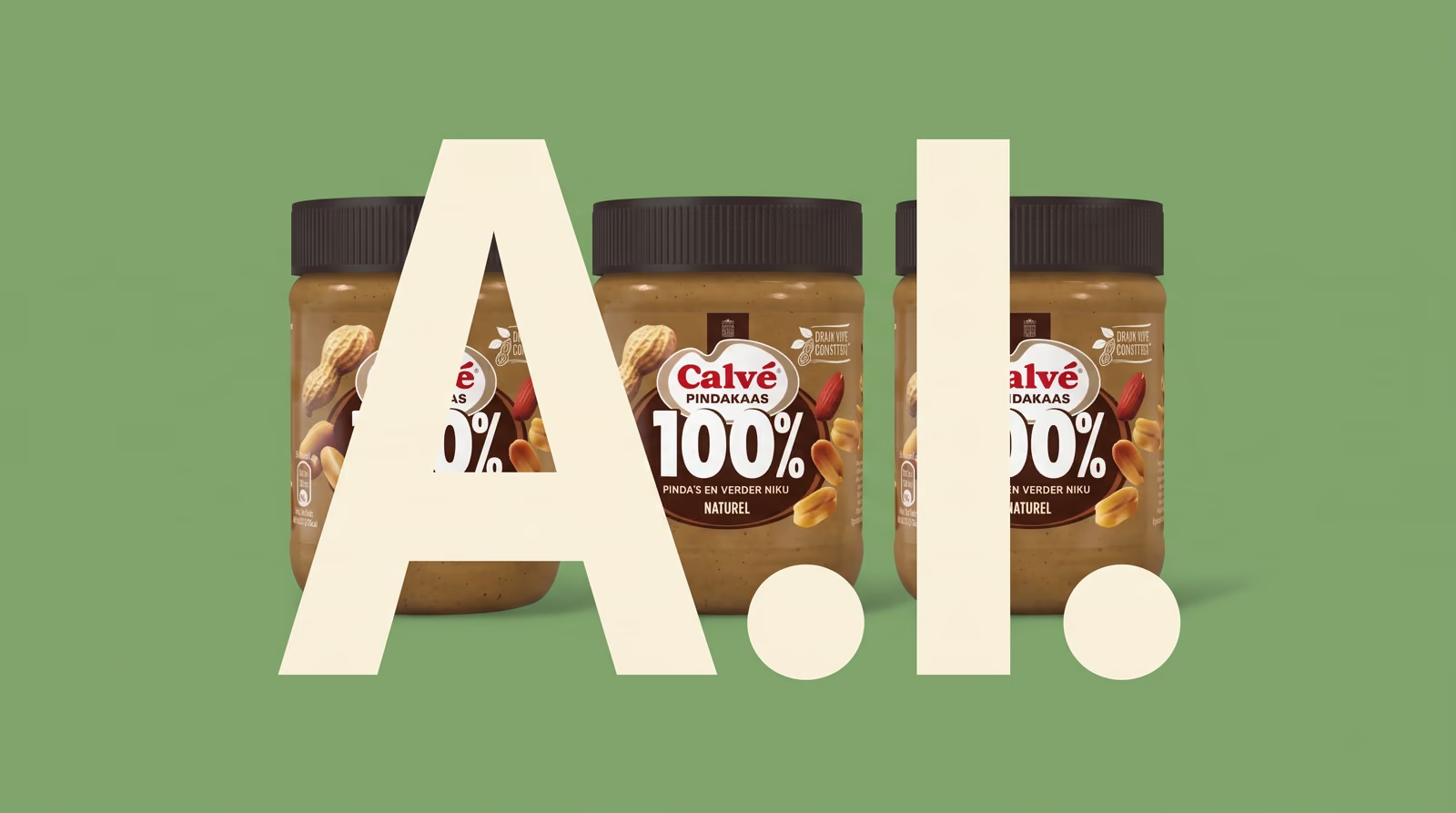
These labels work through the open standard C2PA, also known as Content Credentials. A label can record which program created or edited a file, which AI model was involved, who signed it and when. The label is digitally signed, so any tampering shows up immediately.
You usually need a special reader to see a label. With the Content Credentials verification tool you can upload a file and view the label yourself.
So a provenance label tells you much more than a watermark.
The watermark says that AI was involved. The label says which model, which user, which licence and when.
AI detection remains an estimate
The third technique is of a different order. An AI checker looks at a text from the outside and calculates a probability. The checker looks at style, sentence structure and typical AI traits, such as an excess of dashes.
A checker like that has never seen the creation process itself. That means it can be wrong in two directions. AI text slips through and a text your best writer wrote personally wrongly gets an AI stamp.
This happens more often than you think. Researchers at Stanford found that AI checkers wrongly flagged more than half of the English essays by non-native writers as AI.
Compare it with your visitor figures. An estimate from an external tool is something different from the measurement in your own analytics.
Detection is a suspicion, provenance is a measurement at the source.
So use a checker at most as a reason to ask a question and never treat the result as proof.
What a mark tells you and what it leaves open
Many business owners think a mark means that AI wrote the text. That is rarely true. A mark only tells you that an AI model was involved somewhere in the process.

That could be when coming up with an outline, for a first draft, during editing or in a final check. Every step can leave a trace. A skilled writer who only has AI check the commas can carry the same mark as someone who had the entire text generated. What is more, the mark says nothing about quality.
It works the other way round too. If you find no mark anywhere, AI may still have been involved. The content may be older than the technique, heavily edited, or the data may have been stripped along the way.
This is what a mark tells you.
- An AI model was involved somewhere in the creation process.
- The mark travels along when someone copies and pastes the content.
- Light editing usually leaves the mark in place.
A mark that is found tells you something small and true. A missing mark leaves everything open.
The tool handles provenance, you handle quality
That brings us to the heart of the matter. There are two separate questions. Where does the content come from and is the content good?
AI tools largely answer the first question for you. They add the watermark and the label. Your only choice is whether to tell readers that AI helped.
Nobody answers the second question for you. Quality comes from your knowledge, your experience and your judgement.
Provenance is a small matter that only applies if you use AI. Quality applies to everyone and is exactly where you make the difference.

Why 2026 is the tipping point
This year, AI transparency is shifting from voluntary towards mandatory. The European AI Act came into force in August 2024 and its rules are taking effect step by step.
On 2 August 2026 Article 50 of the AI Act took effect. Since then, providers of AI systems have to ensure that content from their systems is recognisable as AI content in a machine-readable way. Systems already on the market before that date have a short transition period until 2 December 2026.
To make that practical, in June 2026 the European Commission published a code of practice on the transparency of AI content. By the end of July, around 190 organisations had signed it.
For content from before 2 August 2026, labelling after the fact is voluntary, although the Commission encourages it where possible.
The good news for you as a business owner is that the tools do the marking for you.
Whether you disclose your AI use yourself does remain your responsibility.
When do you disclose AI use?
First, an honest caveat. This is an explanation in plain language, intended as a first orientation. If in doubt, put your own situation to your lawyer.
For images, audio and video, the line is clear. If you use AI to create a deepfake, meaning content that looks real and imitates existing people, places or events, you disclose this no later than the first moment someone sees it. Say an estate agent uses AI to furnish an empty living room with a sofa, a rug and a few plants. That photo looks real, so it states right next to it that the furnishing was made with AI. That way a buyer knows in advance what the room really looks like. For clearly artistic, satirical or fictional work, a lighter disclosure that leaves the viewing pleasure intact is enough.

For text, it is more nuanced. If you publish AI-generated text to inform the public on matters of public interest, you disclose that. That obligation lapses when a person reviews the substance of the text and someone holds editorial responsibility for it.
According to the European Commission, only a deliberate review of the substance counts. A quick or purely formal check falls short. The Netherlands Institute for Human Rights gives texts about elections and public health as examples.
A blog about the housing market in your region usually falls outside that category. If you have AI virtually furnish an empty living room, the photo shows an existing home differently from how it really is. So state that clearly with the photo.
A person who reads along critically and takes responsibility is therefore your best protection from the start.
Transparency towards your readers always pays off, too.
Does Google reward human content?
The question business owners ask most often. Will my position in Google drop as soon as Google sees that AI helped write it? The short answer is no, because Google mainly looks at what a page adds.
Google itself has said so since 2023. The search engine rewards helpful, original content, no matter how it was produced. At the same time, mass-producing pages to manipulate rankings falls under scaled content abuse, no matter how that content was made.
Research confirms this picture. Ahrefs analysed 600,000 pages and found virtually zero correlation between the share of AI text and the position in Google. No less than 86.5% of the top pages did contain some AI help.
What Google does penalise is sameness. My fellow SEO Lily Ray tracked more than 220 websites that mass-produced content with AI platforms. After rapid growth, 54% lost at least 30% of their peak traffic. Of all the sites, 39% lost half or more and 22% even lost three quarters or more.
AI only made that approach faster. The sameness itself cost them their rankings.
AI removed the production limit, for everyone at the same time. As a result, volume is no longer an advantage anywhere.
Human content draws the most traffic
These days, roughly as much AI text is published as human text. In early 2026, Graphite's measurement found that 49.9% of all new articles were largely written by AI. Then look at what appears in Google and the picture tilts sharply.
A second analysis by Graphite shows that 86% of the articles in the search results were written by people and 14% by AI. In the very first position, the AI share even drops to 7%. Of the sources that ChatGPT and Perplexity cite, 82% come from people.
So the smallest share of what is published attracts the largest share of the attention.
That is rarely down to an aversion to AI.
Ten pages that give the same answer compete with each other. Google picks one and the rest share the crumbs. Depth and original insight decide which one that is.
Where AI belongs in your work
Quality comes from people. A text with little human value stays weak, whether AI wrote a lot of it or a little.
Work with a lot of human value is strong, with a lot of AI or a little. The difference between the two lies in speed. An expert who does everything personally delivers strong work at a steady pace. An expert who uses AI delivers the same substance faster.
Your people deliver the value, AI delivers the speed.
Use each of them where they are strongest.
A handy rule of thumb. If a strong landing page used to take you 4 hours, still spend at least 2 hours on it. Use the time AI saves to make the piece better, with more examples, sharper choices and your own figures. The goal is better content, the word count matters little.
Think of an estate agent who has AI draft the first outline of a sales story and adds the neighbourhood, the figures and the experience of the viewing themselves.

Write to be cited in AI answers
Until now, this has mainly been about Google. AI assistants read your content in a different way. They pick out individual passages and put them in their answer with a source credit.
That works best with content laid out in clear blocks. Think of lists, comparisons, product pages and overview pages with clear headings and claims that stand on their own.
A beautiful essay of two thousand words is a delight for people to read. For an AI model, it is hard to lift one clear sentence out of it.
So make your best content citable and easy to find.
That rarely calls for a rewrite. Better formatting is often enough.
- Put the key conclusion of each section in the first sentence.
- Use headings that contain a question or a promise.
- Give figures a source, a date and a unit.
- Put comparisons in a table or a list.

You can read how to then get named as a source in our article on mentions in AI answers.
Information gain is your real edge
Volume was never a real edge and neither is removing a mark. The real advantage is called information gain. That is everything your reader learns from you and cannot find elsewhere.
If AI can recreate your article in thirty seconds with a single prompt, you have little edge. After all, AI gives that same answer to everyone, at any moment, through any website.
AI search engines reward precisely the signals that are hard to imitate. Think of demonstrable expertise, real mentions and citations by others. That ties in seamlessly with what Google has called E-E-A-T for years, meaning experience, expertise, authoritativeness and trustworthiness.
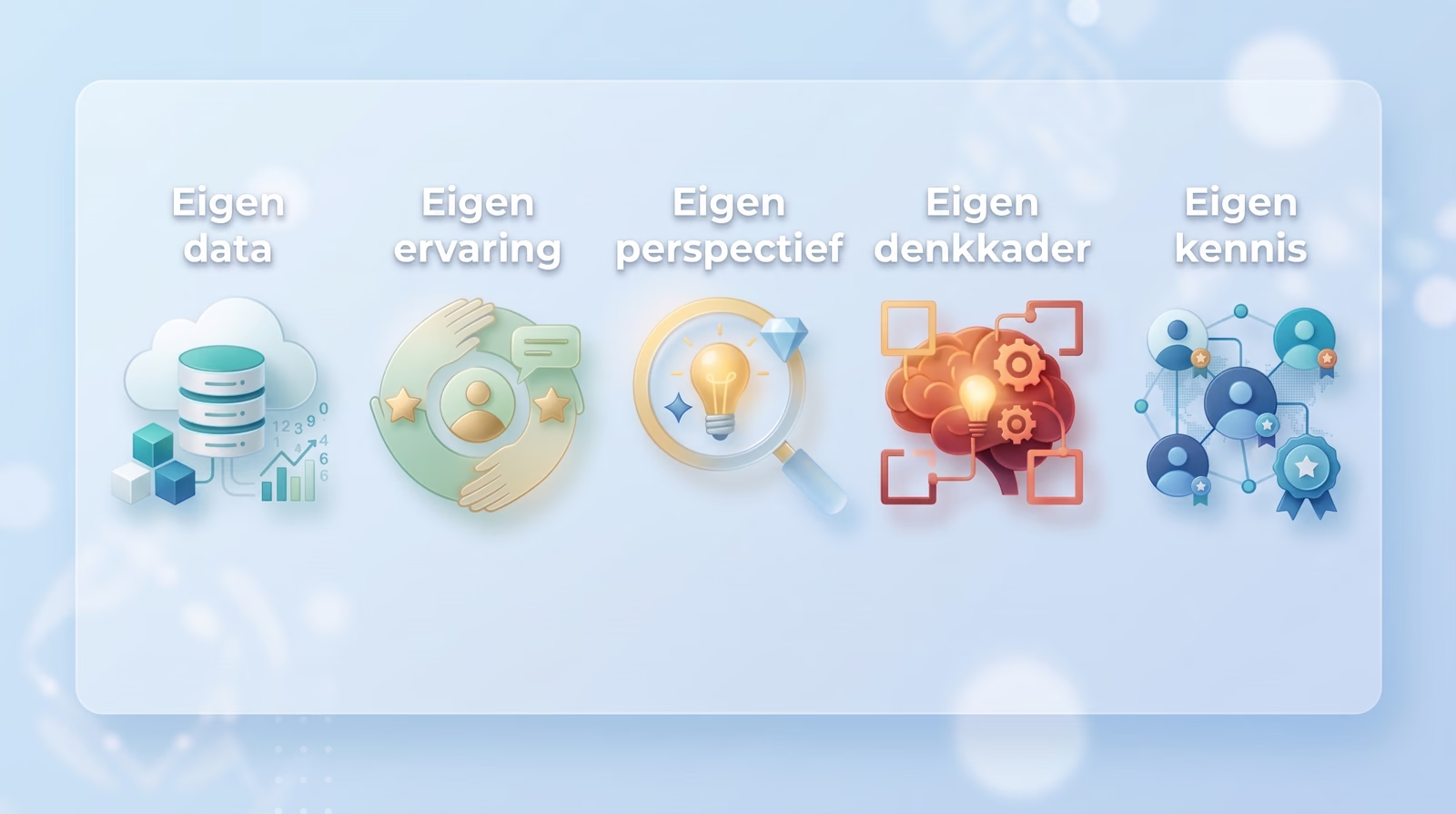
You get information gain from five sources:
- Your own data, such as your own research, surveys or customer figures.
- First-hand experience, from yourself, your team or your customers.
- The perspective of a real expert.
- Your own frameworks, meaning a new way of looking at a problem.
- The knowledge of recognisable people in your field.
Turn a benchmark into a headline
AI effortlessly writes an article about “creating a converting landing page in 2026”. A piece like that points nowhere in your direction. If instead you write “We analysed 6,200 landing pages and this is what generated revenue”, you share something only you have.
Facts are easy to copy. The explanation of why something happened and the advice on what to do with it are much harder to copy.
It is precisely that interpretation and judgement that make you irreplaceable.
Educational content builds the most trust here. Clickbait brings quick visits, explanation brings returning readers and trust ultimately leads to customers.
To see how to show that in AI search engines, take a look at our approach to AI search engine optimisation.
How to tackle it in four steps
Chances are AI is already helping to write in your business. Think of an employee who uses ChatGPT, a freelancer or the agency that makes your newsletter. Do you know exactly where? With that overview, you can later see which texts were made with AI and which deliver the most.
Measure revenue instead of numbers
When publishing was hard, the number of pieces was a logical measure. AI has changed that. From now on, reward your team for what content delivers, meaning enquiries, revenue and customers. The number of articles carries less weight.
It is about different content and much less about more content.

Frequently asked questions about AI watermarks (FAQ)
What is an AI watermark?
An invisible signal that an AI tool embeds in text, images, audio or video the moment that content is created. It is invisible to people, while systems read it and so recognise that AI was involved.
Can I remove an AI watermark?
An invisible watermark is designed precisely to survive edits such as cropping, filters and compression. Light editing usually leaves it in place. Making your content better pays off far more than removing the mark.
Does Google penalise content with an AI watermark?
Google rewards helpful, original content, no matter how it was made. Mass-producing monotonous pages to manipulate rankings does count as spam.
Do I have to disclose that I use AI?
For deepfakes, yes, from 2 August 2026. For text on matters of public interest too, unless a person reviews the substance of the text and holds editorial responsibility for it. If in doubt, put your situation to a lawyer.
How reliable is an AI checker?
A checker makes an estimate based on style and can be wrong in both directions. Use the result as a reason to ask a question and never as proof.
What is information gain?
Everything a reader learns from you and cannot find elsewhere, such as your own data, first-hand experience, expert vision and your own frameworks. That is exactly what AI finds hard to imitate and what search engines reward.